
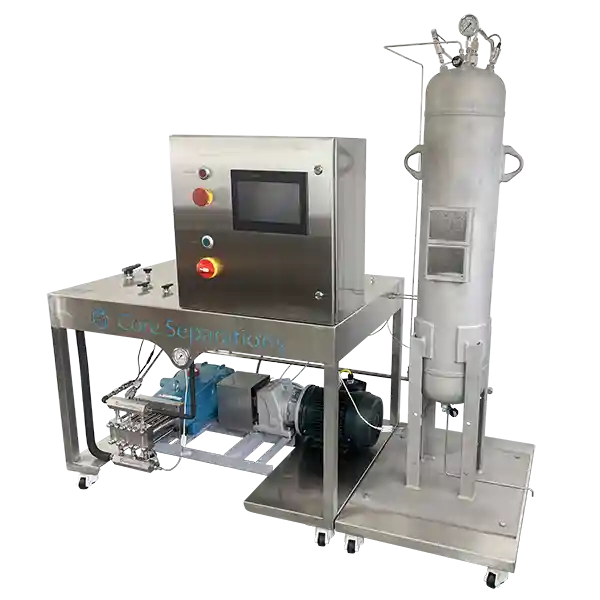
Bulk Delivery
The Core Separations bulk delivery system (BDS) is designed for users operating multiple SFC systems who require an intermediate supply of cryogenic CO₂ without the need for large-scale bulk storage typically provided by major gas suppliers. It offers a cost-effective solution for delivering high-pressure CO₂ to laboratories with continuous demand, while significantly reducing the need for manual handling of individual CO₂ cylinders. The Core Separations BDS can be configured to meet a broad range of requirements, from supplying CO₂ to analytical instruments through to supporting preparative SFC applications with significantly higher CO₂ demands.
Why Bulk Delivery for CO2
Advantages of Cryogenic CO₂ (22 bar) Boosted to 50–80 bar vs Bottle CO₂ for SFC
Using a bulk liquid CO₂ tank with a high-pressure BDS/boost system provides major operational and performance benefits over traditional cylinder bundles for SFC systems:

Continuous, stable liquid-phase CO₂ supply
Cryogenic tanks deliver true liquid CO₂ at ~22 bar, and boosting to 50–80 bar ensures the pump is always fed with a dense, bubble-free fluid. This eliminates cavitation, flow instability, and bubble formation that commonly occur with warm or depleted CO₂ cylinders.

Far higher capacity and longer uninterrupted operation
Bulk tanks hold hundreds to thousands of kilograms of CO₂, removing the need to change cylinders mid-run. This prevents chromatographic interruptions, baseline drift, and downtime during long preparative SFC sequences.

Lower operating cost per kilogram
Bulk CO₂ is significantly cheaper than cylinder CO₂ (often >50% savings). For prep-scale SFC facilities consuming tens to hundreds of kg/day, the cost difference is substantial.

Consistent inlet pressure for improved chromatography
A controlled bulk delivery system provides CO₂ at a stable pressure, enhancing pump efficiency, repeatability, and retention-time reproducibility. Bottles warm and cool during use, causing flow and density variation.

Reduced logistics and safety handling
No more cylinder swaps, transport, pallet storage, or manual handling. The risk of regulator icing, valve damage, or incorrect phase delivery (vapour vs liquid) is dramatically reduced.

Higher reliability for modern preparative SFC skids
Large SFC pumps (e.g., 100–300 mL/min heads) require a constant liquid feed to maintain volumetric accuracy and pressure control. Bottles struggle to sustain this, especially as they approach depletion. Bulk systems maintain consistent density and flow, ensuring proper CO₂ mass delivery.

Minimal risk of running vapour-phase CO₂
Cylinders often flash into vapour as they empty or warm; vapour ingestion causes flow collapse, pressure spikes, and run failures. Boosted cryogenic supply eliminates this by maintaining liquid CO₂ well above its vapour pressure.

Environmental and operational footprint improvements
Fewer deliveries, less waste, fewer cylinders to return or replace, and no venting required during cylinder changeovers.
High-Flow CO₂
Delivery With & Without Cooling
Click the system to reveal more info
No Active Cooling

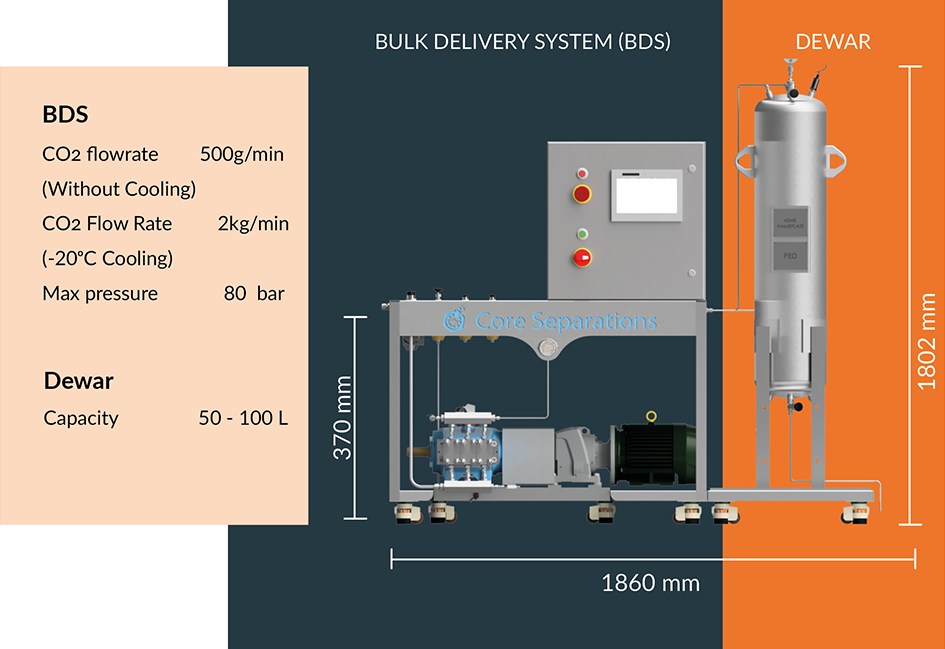
Bulk delivery system (BDS) operates efficiently without the need for cooling on either the pump or the incoming CO₂ supply. Under these conditions, it can deliver up to 500 g/min.
Our bulk delivery system operates efficiently without the need for cooling on either the pump or the incoming CO₂ supply.
Under these conditions, it can deliver up to 500 g/min, depending on the pump model.
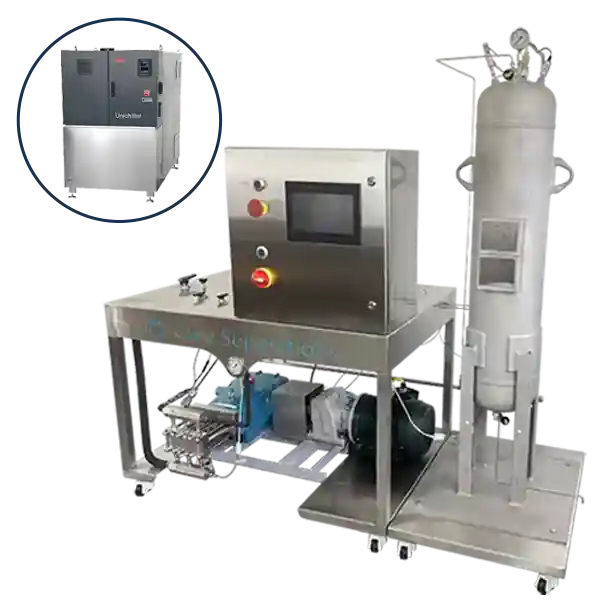
Active Cooling

Applying cooling to both the incoming CO2 and the pump heads significantly enhances system performance — boosting flow rates by up to four times and enabling output of over 2 kg/min. This increased capacity supports greater delivery efficiency, making the system an ideal choice for high-demand applications where consistent performance and reliability are essential.
Intelligent CO₂ Delivery Control
hover to learn more
Intelligent CO₂ Delivery Control
The Bulk Delivery System automates the supply of cryogenic CO₂ by drawing from a source at a suction pressure of 20–22 bar and compressing it to a delivery pressure between 25 and 80 bar. The CO₂ is stored in a pressure-rated tank, which acts as a bulk reservoir for consistent supply to the laboratory. Using Core Separations’ pressure control mode, the system monitors the tank pressure and automatically refills it as needed, ensuring a continuous and stable CO₂ flow without manual intervention.
Expandable Flow Capability
hover to learn more
Expandable Flow Capability
The Bulk Delivery System is designed with upgradeable flow capabilities to suit a range of application demands. In its standard configuration, it delivers up to 500 g/min of liquid CO₂ without requiring active cooling on either the pump or the incoming supply offering a reliable, low-maintenance solution for moderate flow requirements. For higher throughput applications, integrated cooling can be applied to both the CO₂ feed and the pump heads, significantly enhancing performance. With this upgrade, flow rates can exceed 2 kg/min while maintaining stable delivery at –26 °C, making the system ideal for high-demand environments that require consistent, high-volume CO₂ supply.
Constant Pressure Output
hover to learn more
Constant Pressure Output
The system is designed to deliver consistent pressure, making it ideal for pressure-sensitive applications such as SFC. It supports high-pressure delivery to compensate for pressure drops across long transfer lines, helping to maintain CO₂ in its liquid phase throughout the system. This prevents unwanted phase changes to gas, which would otherwise require line purging and disrupt process stability.
How it works
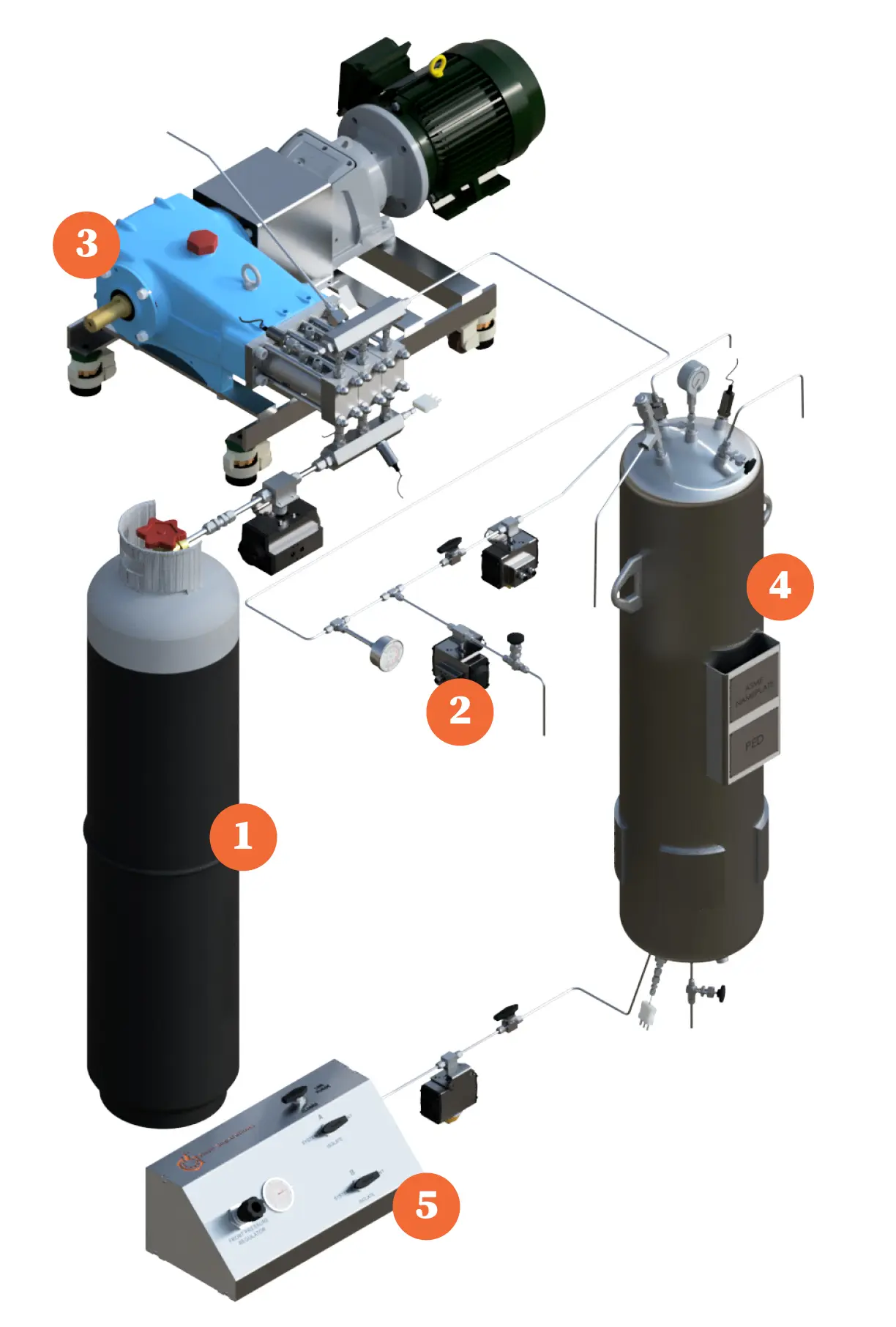
Follow each numbered stage to see how low-pressure cryogenic CO₂ is converted into a continuous high pressure liquid supply.
The bulk delivery system generates high pressure liquid CO₂ from a cryogenic supply operating at approximately 22 bar. It provides a stable, uninterrupted CO₂ feed for instruments that require continuous operation, without the need for active cooling.
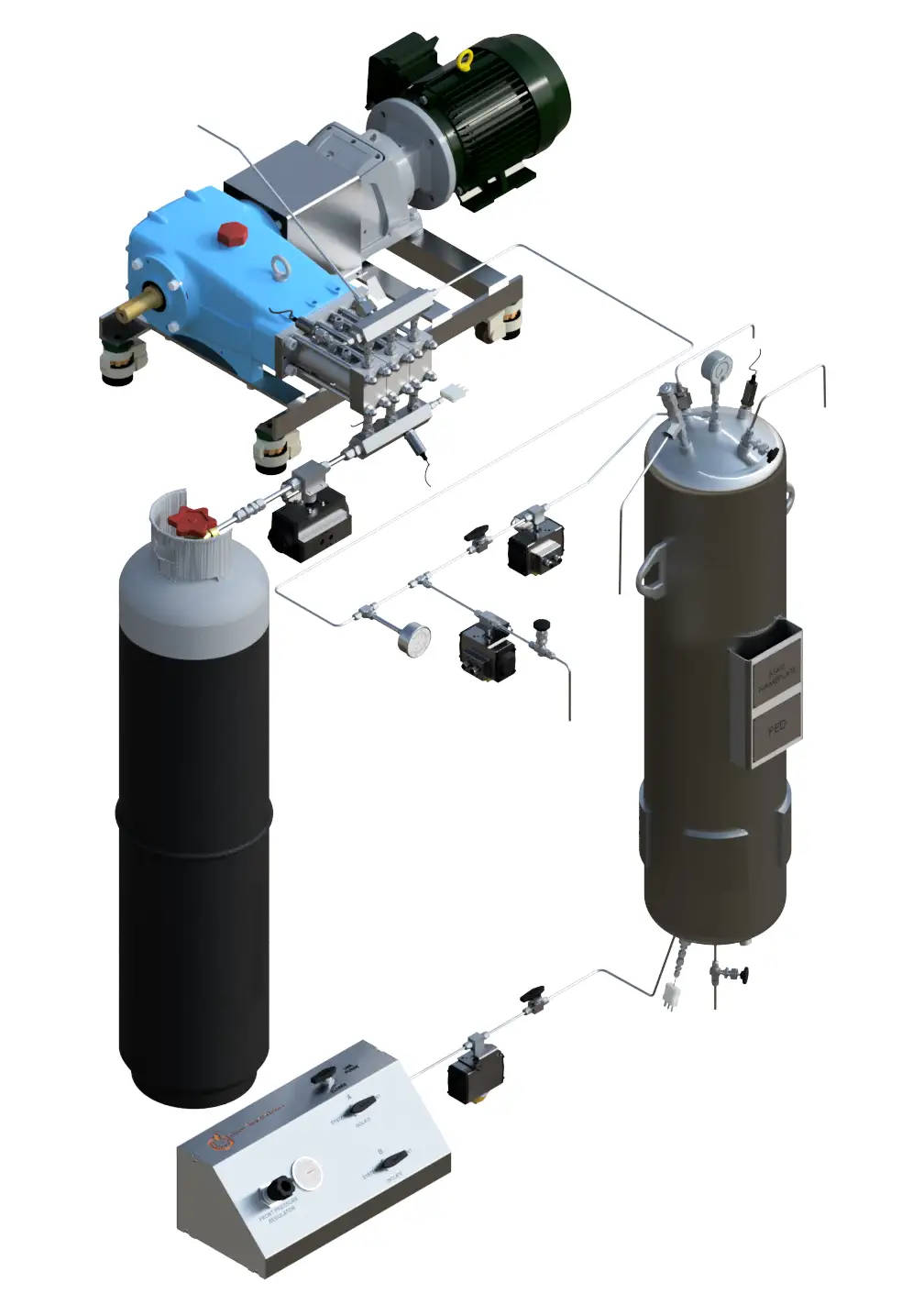
3. Pump pressurisation
Once the purge cycle is complete, the purge valve closes and the valve to the high pressure receiver opens. The pump then operates in pressure mode, increasing the pressure in the receiver vessel to the user set value.
1. Cryogenic CO₂ supply
CO₂ is supplied from a cryogenic storage tank, typically at a pressure between 20 and 22 bar. This can be from portable 220 L cryogenic tanks or from a fixed 1000 L storage tank, provided the supply delivers cryogenic CO₂.
2. Purge cycle
When the pump starts, the inlet valve opens automatically. The system begins by purging the lines, using the natural cooling effect created by releasing CO₂. This helps vent any gas present in the lines while also cooling the pump heads, preparing the system for efficient liquid CO₂ transfer.
4. High pressure receiver
The high pressure receiver stores the CO₂ ready for delivery to the instrument or system. When the pressure in the receiver falls below the set range, the pump automatically runs through its purge cycle and then repressurises the vessel back to the required pressure.
5. Constant pressure delivery
Because the pump operates in pressure mode with hysteresis, a manifold is installed close to the instrument and fitted with a forward pressure regulator. This ensures a stable and constant CO₂ delivery pressure at the point of use.
1. Cryogenic CO₂ supply
CO₂ is supplied from a cryogenic storage tank, typically at a pressure between 20 and 22 bar. This can be from portable 220 L cryogenic tanks or from a fixed 1000 L storage tank, provided the supply delivers cryogenic CO₂.
2. Purge cycle
When the pump starts, the inlet valve opens automatically. The system begins by purging the lines, using the natural cooling effect created by releasing CO₂. This helps vent any gas present in the lines while also cooling the pump heads, preparing the system for efficient liquid CO₂ transfer.
3. Pump pressurisation
Once the purge cycle is complete, the purge valve closes and the valve to the high pressure receiver opens. The pump then operates in pressure mode, increasing the pressure in the receiver vessel to the user set value.
4. High pressure receiver
The high pressure receiver stores the CO₂ ready for delivery to the instrument or system. When the pressure in the receiver falls below the set range, the pump automatically runs through its purge cycle and then repressurises the vessel back to the required pressure.
5. Constant pressure delivery
Because the pump operates in pressure mode with hysteresis, a manifold is installed close to the instrument and fitted with a forward pressure regulator. This ensures a stable and constant CO₂ delivery pressure at the point of use.
Certification
-
 I
I
-
 I
I
-
 I
I
-
 I
I