
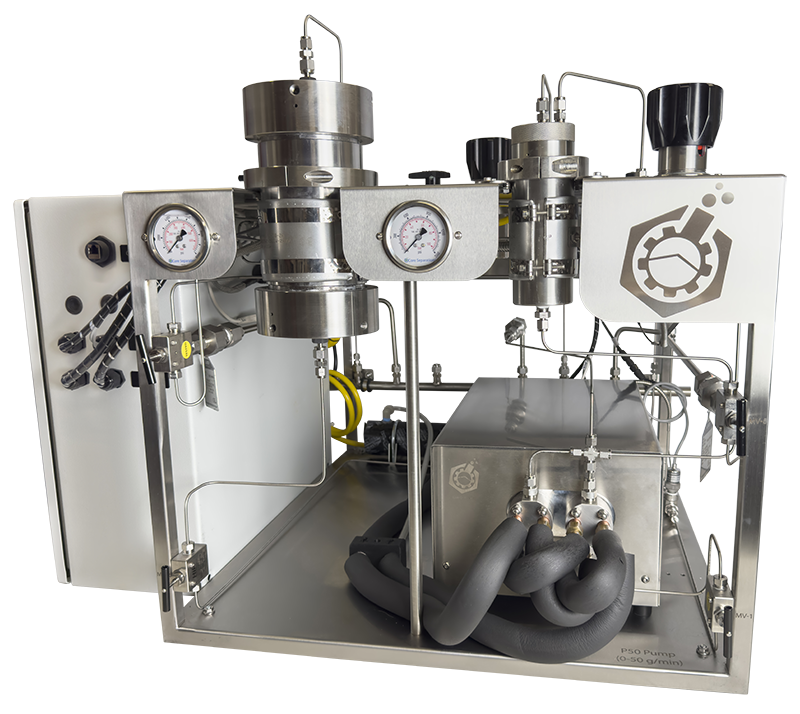
Benchtop
Our benchtop system is designed for users exploring supercritical fluid processing.
Compact enough to fit on a bench or inside a fume cupboard, this system retains all the key features of our larger systems: flexibility, robustness, and precise control. Like our larger SFX systems, the benchtop version utilises the same SFX software and Adaptive Pressure Control (APC™), enabling users to easily scale up and advance in their journey.
Why consider a Benchtop system
Compact CO₂ extraction without compromise
Benchtop extraction systems are designed for laboratories that need the capability of a larger CO₂ extraction platform in a smaller, more accessible format. They are ideal for teaching, research and early stage process development, offering controlled pressure, temperature, CO₂ flow and co-solvent addition while keeping sample requirements, system footprint and laboratory demands low.

Compact System with Full Process Capability
A benchtop extraction system offers the core functions of a larger supercritical CO₂ extraction platform within a smaller laboratory footprint. Users can control pressure, temperature, CO₂ flow, and co-solvent addition without the extensive space or infrastructure required for a larger pilot-scale system.

Ideal for Teaching and Training
Smaller vessel sizes make this system perfect for teaching laboratories and practical demonstrations. Students and new users can observe how pressure, temperature, flow, and collection impact an extraction process on a system that mirrors the principles of larger equipment.

Lower Sample and Solvent Requirements
The 50 mL and 100 mL formats are particularly useful when sample material is limited, expensive, or only available during early research phases. Smaller extraction volumes reduce the necessary feed material, CO₂, and co-solvent, making exploratory work more practical and less wasteful.

Faster Exploratory Process Development
Benchtop systems enable users to screen extraction conditions before committing to larger sample volumes. Pressure, temperature, CO₂ flow, and co-solvent percentage can be adjusted to observe process responses, helping researchers quickly identify promising conditions.

Manual or Automated Control Options
The system can be configured for simple manual operation or with automated back pressure control for more precise and repeatable studies. This flexibility allows users to select the level of control needed for their application, from basic teaching to advanced research and method development.

Controlled CO₂ Delivery and Flow Measurement
Accurate CO₂ pump control and flow metering allow users to treat CO₂ flow as a true process variable, rather than merely a means of achieving pressure. This is crucial for comparing extraction results, understanding process efficiency, and generating data to support future scale-up efforts.

Co-Solvent Capability
The addition of a co-solvent pump enables users to explore applications where CO₂ alone may not provide sufficient solvating power. This enhances the system’s flexibility and supports method development for compounds with varying polarity, selectivity, or extraction behaviour.

A Bridge Between Research and Larger Scale Systems
Despite its compact size, the benchtop range is designed with the same control philosophy as larger Core Separations systems. This allows users to develop an understanding of process variables on a smaller platform before transferring that knowledge to larger extraction systems where sample throughput and production capacity are paramount.
Benchtop Systems
The benchtop supercritical CO₂ extraction range delivers the capabilities of a larger system in a compact laboratory format. Available with 50 mL, 100 mL, 500 mL, and 1 L extraction vessels, it supports teaching, research, exploratory process development, and space-limited laboratories. Systems can be configured with manual pressure control or automated back pressure regulation, with CO₂ pump flow control, flow metering, and co-solvent delivery available for controlled, repeatable extraction studies. This makes the range a practical choice for users who need compact equipment without compromising process control or experimental flexibility.
50 mL Benchtop Extraction System
The 50 mL benchtop extraction system is designed for teaching, demonstrations, and initial exploratory work where sample size, laboratory space, or material availability may be limited. Despite its compact size, the system can be configured with the same core control philosophy as a larger extraction platform, including manual or automated back pressure control, CO₂ pump flow control, flow metering, and co-solvent delivery. This makes it a practical entry-level system for understanding the principles of supercritical CO₂ extraction while retaining meaningful process control.
System’s technical specifications:
| Extractor Volume: | 2 x 50mL |
| Max operating Pressure: | 600 bar (8700 psi, allowance for relief or safety devices) |
| Max Operating Temperature: | Upto 150 C |
| Max Operating Flow CO2: | 0.9 kg/h |
Dimensions:
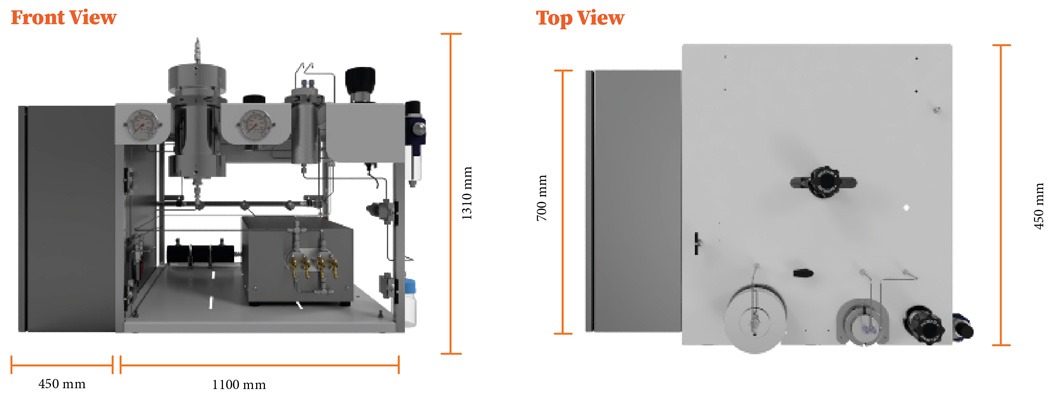
100 mL Benchtop Extraction System
The 100 mL benchtop extraction system provides a compact yet capable platform for education, screening, and small-scale research. It offers a useful increase in vessel volume compared to the 50 mL model, while remaining well-suited for laboratories with limited space. The system can be designed with automated back pressure control or manual pressure regulation, controlled CO₂ delivery, flow meter feedback, and co-solvent pump integration, allowing users to investigate the effect of pressure, flow, and solvent composition on extraction performance.
System’s technical specifications:
| Extractor Volume: | 100mL |
| Max operating Pressure: | 600 bar (8700 psi, allowance for a relief or safety device) |
| Max Operating Temperature: | Upto 150 C |
| Max Operating Flow CO2: | 0.9 kg/h |
Dimensions:
500 mL Benchtop Extraction System
The 500 mL benchtop extraction system is intended for research and exploratory process development, where a larger sample capacity is required without transitioning to a full pilot-scale unit. It gives users the ability to generate more representative extraction data while maintaining the flexibility and accessibility of a benchtop platform. With options for automated or manual back pressure control, CO₂ pump flow control, flow measurement, and co-solvent addition, the 500 mL system provides a strong balance between compact design and process capability.
System’s technical specifications:
| Extractor Volume: | 500mL |
| Max operating Pressure: | 600 bar (8700 psi, allowance for relief or safety device) |
| Max Operating Temperature: | 150 C |
| Max Operating Flow CO2: | 0.9 kg/h |
Dimensions:
1L Benchtop Extraction System
The 1 L benchtop extraction system offers the highest capacity within the benchtop range and is well-suited for advanced research, feasibility studies, and small-batch extraction work. It is designed for users who need more processing volume while still requiring a compact system for laboratories where space is limited. The system can include automated back pressure control or manual operation, accurate CO₂ pump flow control, flow metering, and co-solvent pump delivery, giving researchers a capable platform that reflects many of the control features found on larger extraction systems.
System’s technical specifications:
| Extractor Volume: | 1L |
| Max operating Pressure: | 600 bar (8700 psi, allowance for relief and safety device) |
| Max Operating Temperature: | 150 C |
| Max Operating Flow CO2: | 0.9 kg/h |
Dimensions:

Adaptive Pressure Control
hover to learn more
Adaptive Pressure Control
Accurate pressure control is essential in supercritical CO₂ extraction, but CO₂ can change rapidly in density and compressibility as it moves from a high density liquid like state to a lower density supercritical fluid. These transitions can make conventional PID loop control difficult, often causing overshoot, hunting or slow stabilisation. Core Separations systems use an adaptive pressure control approach that compensates for changes in CO₂ behaviour, helping maintain stable and accurate pressure regulation across changing operating conditions. This improves repeatability and gives users greater confidence when developing or transferring extraction methods.
Continuous and Batch Operation
hover to learn more
Continuous and Batch Operation
Supercritical CO₂ extraction is often associated with continuous CO₂ flow, but some processes require a static hold period where pressure is maintained without constant solvent movement. Core Separations pumps include pressure mode as a standard feature, allowing the pump to control directly to a pressure setpoint. Using PID pressure control, the pump slows as it approaches the target pressure and then tops up only as required to maintain stable conditions. This makes the system suitable for both continuous flow extraction and batch style processes where controlled static pressure is more important than continuous CO₂ throughput.
Flexible Research Control
hover to learn more
Flexible Research Control
A true CO₂ research system needs flexible control, not just fixed setpoints. Core Separations software allows users to tune pressure and temperature response, define ramp rates for heating, pressurisation and depressurisation, and use recipes to automate complex pressure and temperature profiles. This supports repeatable method development and gives researchers greater control over processes where operating history can affect the final result.
How it works
Follow each numbered stage to see how liquid CO₂ is pressurised in bench top system.
The bench top CO₂ system takes liquid CO₂ from a supply cylinder and converts it into a controlled high pressure process stream. After pumping, the CO₂ is preheated to supercritical conditions before it reaches the extraction vessel. The CO₂ pump, vessel heating, back pressure regulation, flow measurement and collection path work together to maintain stable pressure, temperature, flow and process time.
This allows users to run repeatable CO₂ extraction and process development studies at laboratory scale, with manual or automated control depending on the system configuration.
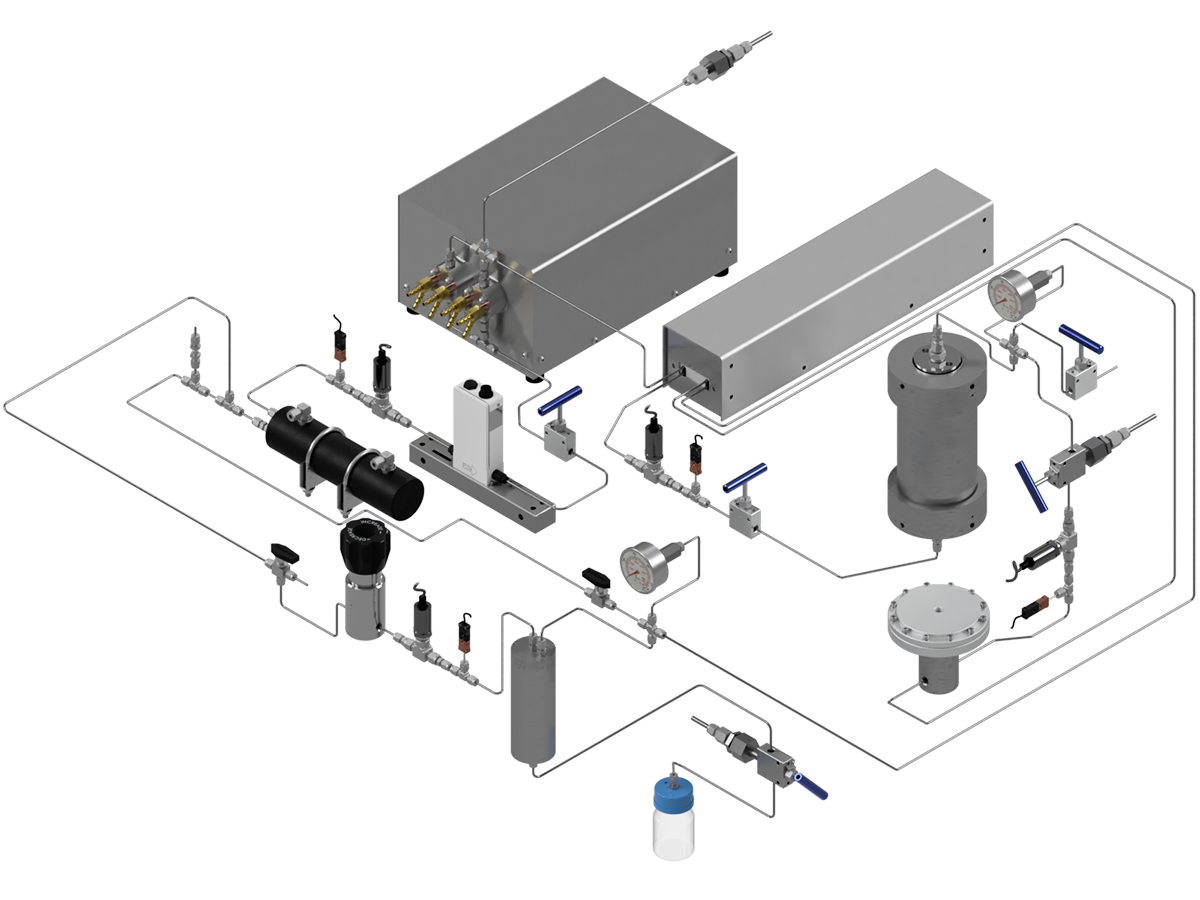
2. Core | Condenser
Although we use a liquid CO2 feed in our extraction systems, it’s important that the incoming CO2 remains liquid. The condenser acts to maintain the incoming temperature of the CO2 ensuring it remains a liquid during the pumping phase. Additional condensers can be added with higher flow rate pumps or the addition of a recycling unit.
3. Core | Flow Meter
Using a mass flow meter corrects the speed of the pump as the density varies, allowing us to accurately deliver the correct mass of CO2 during an extraction. We can observe the in-coming CO2 densities in real time into the system which helps us quickly diagnose any problems with the incoming CO2 supply.
4. Core | CO2 Pump
The pump is designed for minimal pulsation using two pistons for an operating pressure range of up to 689 bar. Pump heads are cooled for efficient operation by removing compression heat, using circulating chilled fluid via cooling tubes inserted into machined cavities in the pump head.
5. Core | Pre-Heater
The pre-heater is located just after the pump to control the temperature of the CO2 reaching the extractor. It ensures the CO2 entering the extraction vessel is already at the optimum extraction temperature ensuring a controlled extraction process.
6. Core | Extraction Vessels
The double-ended vessel comes with threaded closures for easy, fast and safe opening. Its sealing design allows for hand-tight operation for the end caps that are also fitted with frits to retain feedstock. The vessel is electrically heated with a heat jacket and thermocouple for temperature control.
7. Core | Inlet and Outlet Valves
Inlet and Outlet valves – These valves allow the entry and exit of CO2 into the extraction vessels.
8. Core | Automatic Back Pressure Regulator (ABPR)
The pneumatically actuated diaphragm acts on the needle assembly within the regulator to automatically regulate the extraction pressure in the system.
9.Core | Vaporiser
The Joule-Thomson effect is observed when we go from a high pressure to a low pressure resulting in a drop in temperature. To overcome this, we use a Vaporiser to heat the CO2 exiting the ABPR. The vaporiser also helps to expand the CO2 from its liquid state into a gas in-order to help precipitate the extracted components.
10.Core | Separator
The mixture leaving the extractor, composed of extract/CO2 and solvent, is depressurised in one or more separators. At each pressure stage, the extract is separated from the CO2 at the desired pressure, before the CO2 is recycled or vented after the last separator.
11.Core | MBPR
By modifying the pressure and temperature in each separator the density can be accurately controlled to favour the precipitation of some components over others. The manual back pressure regulators facilitate the control of the pressure in each of the separators.
Specification Downloads
Certification
-
 I
I
-
 I
I
-
 I
I
-
 I
I

Meets Application

Contact INFO
USA HQ:
2834 Geesling Rd, Denton, TX 76208
European Office:
Unit B4, The Embankment Business Park
Vale Road, Stockport SK4 3GN
Copyright Ⓒ 2024 Core Separations