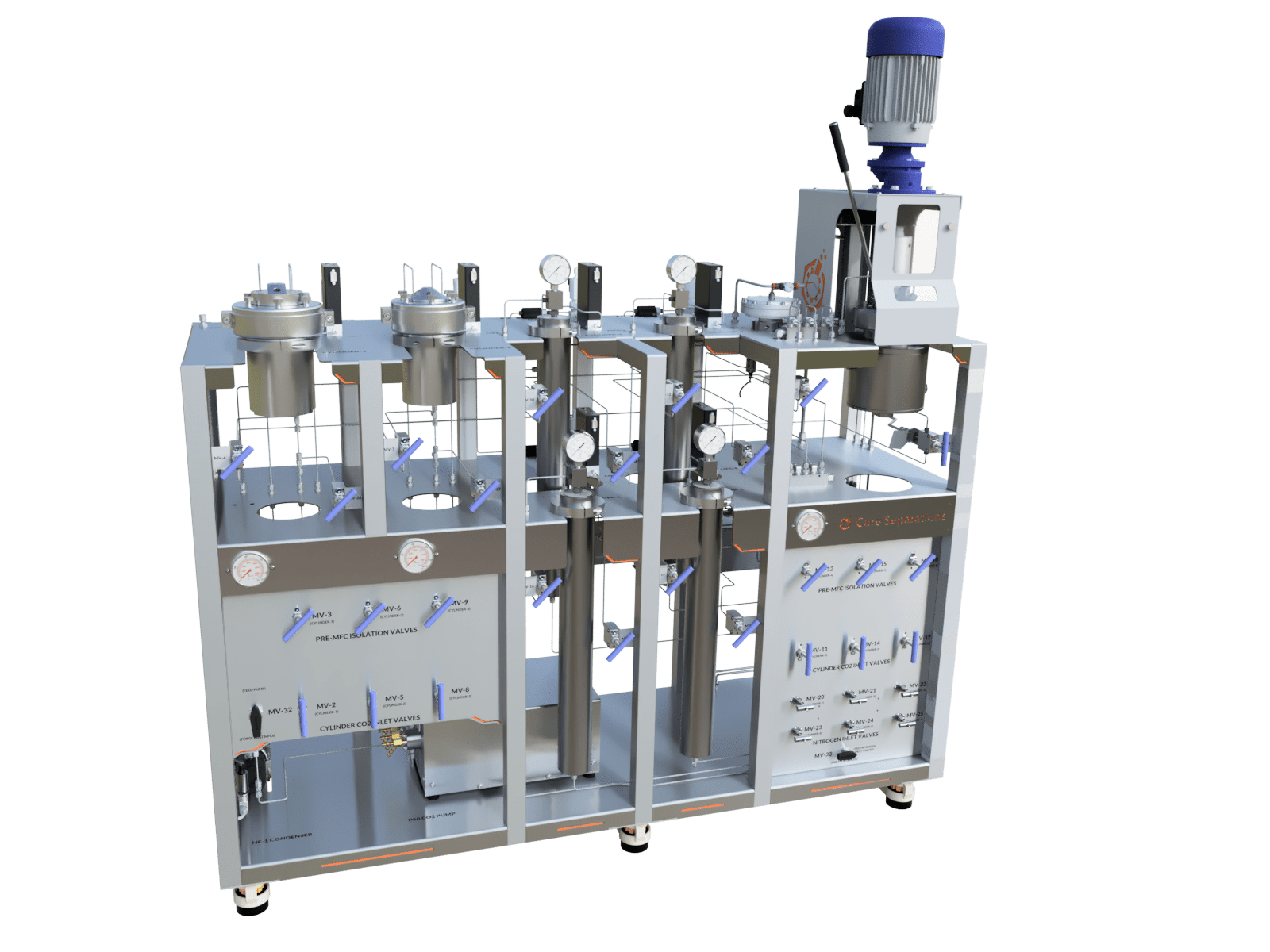
CCS: Corrosion Dosing System
The Core Separations CO₂ Corrosion Dosing System creates controlled CO₂ streams containing defined concentrations of water and gaseous impurities. Available for gas phase and dense phase operation, it enables laboratories to reproduce representative transport and storage conditions for corrosion testing.
The system provides precise control of pressure, composition and flow, with configurations available up to 35 bar for gas phase studies and 200 bar for dense phase CO₂ studies.
Why consider a CO₂ Corrosion Dosing system
Reproducing captured CO₂ transport conditions
Captured CO₂ must be transported from the capture facility to its storage or utilisation location, whether by pipeline, ship, road tanker or another transport network. Existing oil and gas infrastructure may be considered for this purpose, but it was not necessarily designed for exposure to captured CO₂ streams.
Depending on the capture process, the CO₂ may contain impurities such as water, oxygen, hydrogen sulphide, sulphur oxides and nitrogen oxides. Water and CO₂ can form carbonic acid, while interactions with other impurities may create more aggressive corrosive environments.
Controlled laboratory testing helps researchers investigate how these compositions affect pipelines, valves, seals, coatings and other materials used throughout CO₂ transport and storage infrastructure.

Controlled Impurity Composition
Introduce water and gaseous impurities at controlled concentrations to reproduce different captured CO₂ compositions. Mixtures can include H₂S, O₂, SOₓ and NOₓ, depending on the application and required operating envelope.

Gas and Dense Phase Operation

Continuous Flow Corrosion Studies

Precise Mass Flow Control

Stable Pressure Control

Customisable System Configuration

Integration with Corrosion Test Equipment
Long Duration Testing
Corrosion Dosing System
The Corrosion Dosing System is designed to prepare and continuously deliver controlled CO₂ compositions for corrosion, materials compatibility and CCUS research. Up to six independently controlled dosing channels can combine a main CO₂ stream with prepared CO₂ based mixtures, including water saturated CO₂ and CO₂ containing defined concentrations of impurities such as H₂S, SO₂, NOx or O₂. Each stream is independently metered before being combined and delivered to the customer’s test arrangement under controlled pressure and flow. This allows researchers to reproduce complex CO₂ environments with defined water content and impurity concentrations while retaining control over their own test cell, flow loop, sample arrangement and analytical method.
Corrosion Delivery System - Gas
Designed for operation up to 35 bar, the gas phase system enables corrosion and materials testing using controlled lower pressure CO₂ compositions.
The required composition can be produced by combining CO₂ with independently controlled impurity streams using mass flow control. Where suitable compositions are commercially available, premixed gas cylinders can also be incorporated as part of the supply arrangement. Up to six independently controlled dosing channels can be configured to create the required stream composition.
Each stream is accurately metered before being combined and continuously delivered at the selected pressure and flow through a customer supplied test cell, autoclave, flow loop or analytical system.
System’s technical specifications:
| Specification | Gas phase system |
| Maximum operating pressure | 35 bar |
| Typical operating phase | Gas |
| Number of dosing channels | Up to 6 |
| Possible impurities | H₂S, O₂, SOₓ, NOₓ |
| Flow control | Gas mass flow controllers |
| CO₂ flow | TBC |
| Pressure control accuracy | +/- 2 bar |
| Test equipment | Customer supplied |
Corrosion Delivery System - Dense Phase
Designed for operation from approximately 55 to 200 bar, the dense phase system enables corrosion and materials testing under conditions representative of high pressure CO₂ transport, injection and storage.
Because customised dense phase CO₂ mixtures are not commonly available, the system uses a principal CO₂ supply together with prepared CO₂ based dosing streams. These can include water saturated CO₂ and CO₂ containing defined concentrations of impurities. Up to six independently controlled dosing channels can be used to create the required stream composition.
Each stream is accurately metered before being combined and continuously delivered at the selected pressure and flow through a customer supplied test cell, autoclave, flow loop or analytical system.
System’s technical specifications:
| Specification | Dense phase system |
| Maximum operating pressure | 200 bar |
| Typical operating phase | Liquid or dense phase CO₂ |
| Number of dosing channels | Up to 6 |
| Possible impurities | H₂S, O₂, SOₓ, NOₓ and water |
| Flow control | Coriolis meter and proportional control valve |
| CO₂ flow | 0.1 to 1,000 g/h |
| Pressure control accuracy | Approximately ±2 bar |
| Test equipment | Customer supplied |
Pressure Mode CO₂ Supply
hover to learn more

Pressure Mode CO₂ Supply
Custom dense phase CO₂ mixtures are not commonly available from standard gas suppliers. Core Separations uses its CO₂ pumping technology to pressurise liquid CO₂ and create a controlled supply between approximately 55 and 200 bar.
Pressure mode maintains the contents of the high pressure supply cylinder at the selected pressure, automatically adjusting pump operation as demand changes. This provides a stable supply for extended corrosion experiments.
Adaptive Pressure and Flow Control
hover to learn more

Adaptive Pressure and Flow Control
The stream can then pass to an analyser or suitable downstream collection system for composition monitoring or further analysis.

Precise Gas and Dense Phase Dosing
hover to learn more

Precise Gas and Dense Phase Dosing
Gas and liquid metering technologies can be combined within one system, allowing each channel to be configured for its particular fluid, pressure and required concentration.
How it works
CCS: Corrosion Dosing System
The system provides precise control of pressure, composition and flow, with configurations available up to 35 bar for gas phase studies and 200 bar for dense phase CO₂ studies.
Flow through system
Upto 6 mixing channels
Maximum pressure upto 180 bar
Dense phase and gas phase mixing
Adaptive pressure control
| Component | Description |
|---|---|
| A | Flow-through system |
| B | Up to 6 mixing channels |
| C | Maximum working pressure 180 bar |
| D | Dense phase and gas phase mixing |
| E | Adaptive pressure control |